
The homes in Spanaway are mostly wood-frame detached houses built from the late fifties through the seventies, and the electrical contractors in Tacoma who work them regularly know what that means: panels sized for a fraction of today's load, two-prong outlets in older rooms, and circuits that trip the moment a second appliance runs. Calling for expert electrical panel upgrade is often the first conversation a Spanaway homeowner has with a local electrician.
These houses have specific histories baked into their walls, and a local electrician who works Spanaway regularly reads those histories without needing a tour.
Knowing Spanaway Homes Changes How the Work Gets Done
A local electrician working in Spanaway knows that most of these houses sit on crawlspaces, carry their panels in the garage or a utility closet, and were built when sixty to one hundred amps was considered plenty. That knowledge shapes every estimate before a single cover plate comes off.
Two jobs come up constantly in Spanaway: panels that have no room for a new breaker and circuits that cannot carry what a modern kitchen or bathroom demands. Homeowners across Lakewood, WA residential electricians territory see similar issues in houses of the same age.
A problem spotted early in one of these houses costs a fraction of what it costs after it has been left to develop for another season.
Work Matched to How Spanaway Homes Are Actually Built
An off-the-shelf approach fails in Spanaway because running a new circuit through a house on a crawlspace is a different job than running one through a slab. The access point, the path the wire takes, and the time on site all change with the structure.
Detached houses here often have garages and outbuildings on the same lot, which means outdoor runs and subpanels that aged separately from the main house. Homes with finished lower levels add another layer of complexity when walls have to stay intact. Reliable GFCI circuit installation comes up often once a homeowner understands what the original wiring missed.
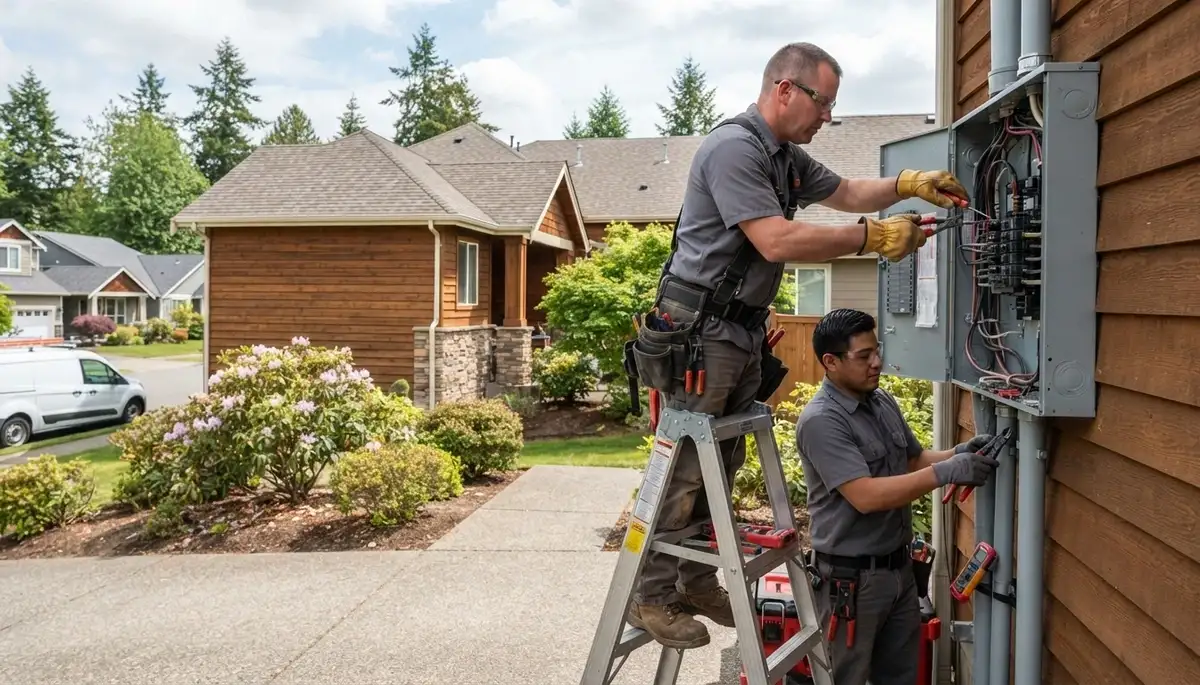
Across Spanaway homes, four services match the construction directly: professional electrical wiring for houses where the original runs are past their useful life, quality electrical panel installation for boxes that have no room left, specialist generator installation for households that cannot afford an outage, and expert outlet repair for the dead or warm outlets that keep showing up in older rooms.
What the Age of Spanaway Homes Still Decides Today
Most of the houses in Spanaway went up from the late fifties through the mid-seventies. Homes built in that stretch came with sixty- or one-hundred-amp service, two-prong ungrounded outlets in most rooms, and in the houses built through the early seventies, aluminum branch wiring that has spent decades expanding and contracting at every connection point. Those three facts still drive most of the electrical work needed here now.
Breaker Box With No Room Left
A homeowner notices it when an electrician opens the panel and every slot is taken, or when the box still runs fuses instead of breakers. Behind that is a service sized for a house with one bathroom, a kitchen without a dishwasher, and no central air. Left alone, it means any new circuit requires a workaround that creates its own problems.
Local electricians replace the panel outright or add a subpanel when the load has grown past what the original box can handle. The fix gives the house room to grow and stops the breaker-juggling that older panels force on the homeowner. Homeowners in Puyallup, WA electrical services territory face the same panel-capacity problem in houses of the same era.
Outlets Warm to the Touch
An outlet that feels warm, or a light that dims when something else on the circuit starts, points to aluminum wiring at the connections. Aluminum wiring was common in homes built through the early seventies, and after decades of use the connections loosen, arc, and generate heat. Left alone, that heat works its way into the wall.
Local electricians add approved connectors at every aluminum-to-device junction or replace the affected runs, depending on how far the problem has spread. After the correction, the outlets stay at room temperature and the lights hold steady when the circuit is under load.
Two-Prong Outlets Throughout the House
Two-prong outlets tell the homeowner that the wiring behind them was installed before grounding was required. That matters most near sinks, in the garage, and anywhere a computer or appliance with a three-prong plug needs a real connection to ground rather than an adapter.
Adding grounded outlets to an ungrounded circuit requires either running a ground wire back to the panel or installing the outlets with test and reset buttons and labeling them correctly. Both approaches bring the outlets up to a standard the original wiring never met, and both reduce the risk the homeowner carries every day.
Modern Loads on a Service That Was Never Sized for Them
A car charger, a heat pump, or a chest freezer added to the garage puts a steady draw on a panel that was sized for a much smaller house. On a hot afternoon, when the air conditioning is already running, that draw pushes the service past what it was built to carry.
Local electricians calculate what the house is actually running, then add a dedicated circuit for the new load or upgrade the service entrance to match. After the work, the homeowner can run the car charger, the air conditioning, and the kitchen at the same time without watching the panel.
Crawlspace Access and Long Runs to Outbuildings
A detached garage or a workshop sitting at the back of a Spanaway lot means the circuit has to travel a long distance underground or overhead, and the crawlspace under the house is often the only path to get the wire started. Tight crawlspaces with low clearance slow the work and raise the cost of anything that requires pulling new wire.
Local electricians who know these houses plan the run before they start, choosing the path that avoids opening walls where the crawlspace can do the same job. The work gets done with the walls intact in most cases, and the homeowner ends up with a circuit that was installed correctly from the panel to the last outlet in the outbuilding.
Call (253) 358-8585 to arrange a no-pressure visit with a local electrician who will look at the panel, the outlets, and the circuits and tell the homeowner exactly what needs attention first.
On Call Electrical handles the work in Spanaway homes so it holds the first time.

Full Electrical Services Available in Spanaway, WA
The list below covers the range of residential electrical work available to Spanaway homeowners. Find the item that matches the situation and call to talk through what the job involves.
Urgent Electrical Repairs in Spanaway, WA
- Electrical Repair - A breaker that will not reset, an outlet that stopped working, or a switch that sparks when touched needs attention before it develops into something larger.
- Outlet Repair - Dead outlets, outlets warm to the touch, or outlets that only work when the plug is held at an angle are all signs the connection behind the wall has failed.
- Switch Repair - A switch that buzzes, flickers, or has to be held in position to keep the light on is a connection problem, not a quirk of the house.
- GFCI Outlets - Bathrooms, kitchens, and garages in older Spanaway homes often lack the outlets with test and reset buttons that code now requires near water.
- Smoke Detector Installation - Detectors that are more than ten years old or that chirp without stopping need to be replaced before they fail to respond when it matters.
Call (253) 358-8585 when something in the house stops working or starts behaving in a way it did not before.
Panel, Service, and Wiring Work in Spanaway, WA
- Electrical Panel Upgrade - A panel with no empty slots, a box that still runs fuses, or a service under one hundred amps cannot carry what a modern Spanaway home demands.
- Electrical Panel Installation - Replacing a panel that has reached the end of its safe life gives the house a clean starting point for every circuit added afterward.
- Electrical Wiring - Original wiring in houses built through the seventies was sized for far fewer devices than these homes run today.
- Electrical Service - The connection from the utility to the panel is the ceiling on everything the house can draw; a service that was never upgraded is a ceiling that is too low.
- New Construction Wiring - Additions, garage conversions, and accessory structures need wiring that meets current requirements from the first circuit to the last outlet.
Homes in Spanaway that were built before the eighties almost always need at least one of these services before a new load can be added safely.
Safety and Protection Work in Spanaway, WA
- Home Electrical Inspections - An inspection finds the problems a homeowner cannot see: loose connections, undersized wiring, and panels that are past their safe service life.
- Whole Home Surge Protection - A single voltage spike from outside the house can damage every appliance and device connected to the panel at that moment.
- Lightning Surge Protection - Homes with tall trees nearby or on lots without natural shielding carry a real risk of surge damage when lightning hits close.
- GFCI Circuits - Running a GFCI circuit to a bathroom, kitchen, or garage protects the homeowner at the source rather than relying on individual outlets.
- Fire Alarm Installation - Interconnected alarms throughout the house mean that a fire detected in one room wakes the household in every room.
Across Spanaway, WA, the homes most in need of safety work are the ones where the original wiring was never updated and no inspection has been done since the house changed hands. A single visit finds what needs to change and puts the risks in order so the homeowner can address them one at a time without feeling overwhelmed by the list.
Lighting, Outdoor, and Added-Load Work in Spanaway, WA
- Electric Car Charger Installation - A dedicated circuit sized for a Level 2 charger keeps the car ready without pulling from circuits the house depends on for everything else.
- Landscape Lighting - Outdoor lighting runs that were added after the house was built often share circuits with indoor loads they were never meant to share.
- Security Lights - Motion-activated lights on the garage, the back of the house, and the outbuilding need circuits that were planned for outdoor use from the start.
- Generator Installation - A permanently wired generator with a transfer switch keeps the house running when the power goes out, without the risks that come from a portable unit.
- Ceiling Fan Installation - Adding a ceiling fan to a room that was wired only for a light fixture requires a box and a circuit that can carry the motor load.
Spanaway homeowners adding new loads to houses that were not wired for them need a local electrician who understands what the original service can carry and what it cannot, so the addition does not create a problem somewhere else in the house.