Homes in Covington were built mostly through the nineteen-eighties and nineties, and the panels and circuits installed then were sized for appliances and loads that look nothing like what sits in those houses today. The electrical contractors in Tacoma network sends local electricians who know what those panels were rated for and what they are being asked to handle now, including professional electrical panel upgrade work that brings capacity in line with how the house is actually used.
When a breaker will not reset or an outlet feels warm to the touch, a local electrician who already knows these houses gets to the root of it faster than someone starting from scratch.
Knowing Covington Homes Changes What Gets Found
A local electrician working in Covington knows where the panel sits, how the crawlspace runs, and which circuits were added after the original build - details that change how long a job takes and whether the fix holds.
Houses here range from wood-frame homes on crawlspaces to slab-on-grade builds where running a new circuit means opening walls rather than pulling wire through an accessible underfloor space. Work in Auburn, WA next door follows a similar pattern when the construction matches.
If something in the panel or wiring looks off, getting an electrician to look at it before it trips again is the right call.
Electrical Work Matched to How Covington Homes Are Built
An off-the-shelf approach fails in Covington because the crawlspace access, panel location, and original circuit layout all decide what a job actually involves before a single wire is touched.
Wood-frame homes on crawlspaces allow wire runs under the floor, keeping walls intact. Slab-on-grade builds require a different path entirely, and homes with attached garages often have the panel tucked in a utility corner that limits working room. Expert ceiling fan installation in a slab home, for example, means routing through the ceiling rather than up from below.
Four services that fit what these homes need most: quality electrical wiring for homes where original runs are showing age, specialist GFCI circuit installation near sinks and in garages, reliable generator installation for homes without a backup source, and professional home electrical inspection for any house changing hands or carrying new loads.
What the Age of Covington Homes Still Decides Today
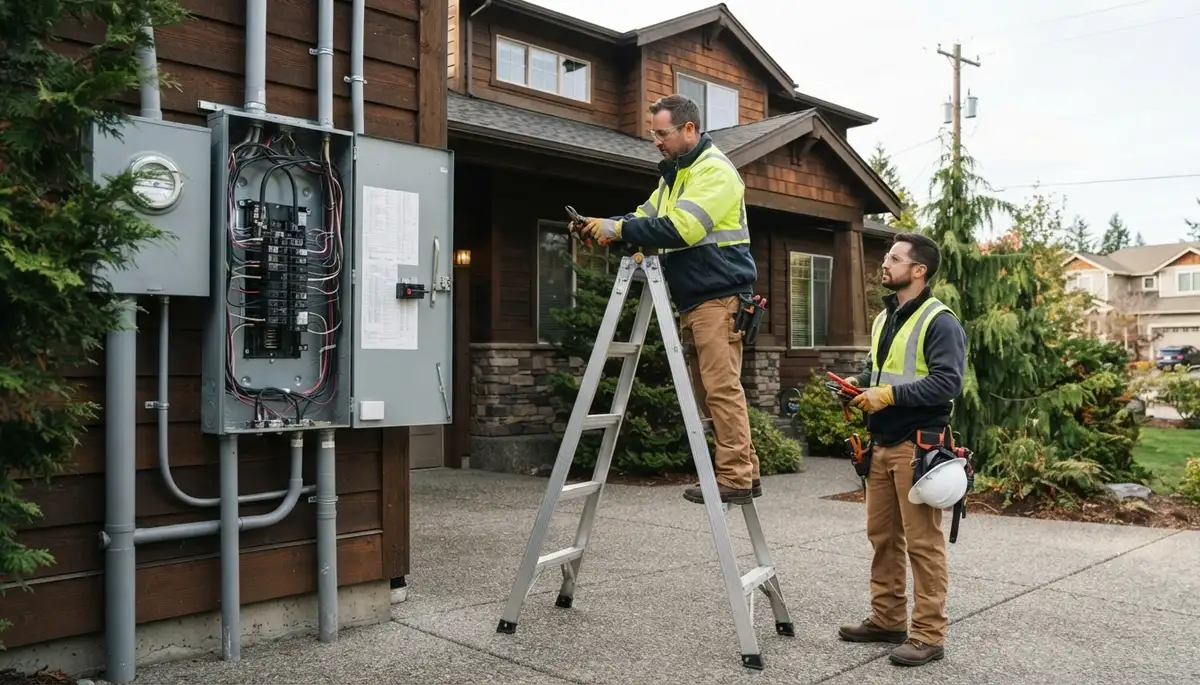
Most houses in Covington went up in the nineteen-eighties and nineties, when panels were sized for a refrigerator, a washer, and a few lights. Those homes now carry car chargers, air conditioning, large kitchen appliances, and home offices - loads the original service was never calculated to handle. Three things follow from that: circuits trip under normal use, panels have no empty slots for new circuits, and outdoor runs added over the years were not always sized for what was later plugged into them.
The panel is full and tripping
A homeowner notices a breaker that trips when the dishwasher and microwave run at the same time, or a panel with no empty slots and a strip of breakers that run warm. Behind it is a service sized for a much smaller house load than what is plugged in today. Left alone, the breakers that trip repeatedly begin to fail, and the ones that do not trip when they should become a fire risk.
Local electricians assess whether the existing panel can be expanded or whether the service needs to be brought up to a higher amp rating. The fix removes the tripping, opens slots for future circuits, and stops the heat that builds at an overloaded box. Homeowners in Bonney Lake, WA with the same panel age see the same pattern.
Outlets with no ground and no reset button
Two-prong outlets in a bathroom or kitchen, or standard outlets near a sink with no test and reset buttons, are what the homeowner sees. Behind it is wiring installed before grounding and the outlets with test and reset buttons were required. That gap leaves appliances and people without the protection those requirements exist to provide.
Adding the outlets with test and reset buttons to the right locations and updating two-prong outlets to grounded three-prong ones corrects the gap. The homeowner gets outlets that work with modern appliances and a house that meets current expectations for those locations.
Lights that dim when something else starts
Lights in one part of the house dim noticeably when the air conditioning kicks on or a large kitchen appliance starts. That dip points to a circuit carrying more than it was sized for, or to connections that have loosened and added resistance over years of use. Repeated voltage dips stress everything on that circuit.
An electrician traces the circuit, tightens or replaces connections, and determines whether the load needs to be split across a new circuit. The dimming stops, and the appliances on that circuit run without the stress of a voltage drop.
A car charger or new air conditioning on an old service
A homeowner adds a car charger in the garage or a new air conditioning unit and the panel starts tripping in ways it never did before. The service was sized for the original load and a car charger or central air alone can push it past what it can handle. A house that runs both at once, along with the rest of the normal load, is asking more than the service was built to give.
Adding a dedicated circuit for the charger or the air conditioning, and upgrading the panel if the amp rating is the limiting factor, gives the homeowner room to run both without watching the breaker box. Future additions can connect to the new capacity without another round of tripping.
Crawlspace access that changes the job
In a home on a crawlspace, the condition of that space - whether it is clean and open or low, wet, and obstructed - decides how long running a new circuit takes and whether it can be done without opening finished walls.
Local electricians assess the crawlspace before quoting the job and plan the route accordingly. When the space allows it, wire runs stay under the floor and the walls stay closed. When it does not, the electrician maps the least disruptive path through the ceiling or inside existing wall cavities and patches what is opened.
Call (253) 358-8585 to arrange a no-pressure visit from a local electrician who can look at what the panel and wiring are carrying and tell the homeowner exactly what needs attention.
On Call Electrical brings straightforward work and results that hold to every Covington home.

Full Electrical Services Available in Covington, WA
The work listed below covers what local electricians handle for Covington homeowners. Find the item that fits the situation and call to talk through it.
Urgent Electrical Repairs for Covington, WA Homes
- Electrical Repair - a breaker that will not reset, an outlet that stopped working, or a switch that sparks when touched
- Outlet Repair - outlets that are warm, loose, or no longer hold a plug securely
- Switch Repair - switches that hum, flicker the lights, or fail to respond
- GFCI Circuits - the outlets with test and reset buttons near water that have stopped tripping or never had them at all
- Smoke Detector Installation - detectors that are past their service life or missing from required locations
If the problem is happening now, call before it gets worse.
Panel, Service, and Wiring Work for Covington, WA Homes
- Electrical Panel Upgrade - panels that are full, run warm, or were sized for a load smaller than what the house carries today
- Electrical Panel Installation - replacing a fuse box or a panel that has reached the end of its useful life
- Electrical Service - the connection from the utility to the panel, assessed and updated when the house load has grown
- Electrical Wiring - original wiring that has aged, been damaged, or was never adequate for the circuits now on it
- New Construction Wiring - complete wiring for an addition, a finished basement, or a new detached structure on the property
Homes built in the eighties and nineties often have panels that were sized for a world without car chargers, home offices, or central air running at the same time.
Safety and Protection Services for Covington, WA Homes
- Home Electrical Inspections - a full look at the panel, wiring, outlets, and grounding before buying, selling, or adding a major load
- Whole Home Surge Protection - a device at the panel that stops a voltage spike from reaching every appliance in the house
- Lightning Surge Protection - protection sized for the surges that travel through the service entrance during a storm
- Fire Alarm Installation - interconnected alarms that alert the whole house when one detector triggers
- GFC Outlets - the correct outlet with test and reset buttons installed in bathrooms, kitchens, garages, and outdoor boxes
A home electrical inspection finds the problems that are not yet causing symptoms - the loose connection, the undersized wire, the outlet that is a risk before it becomes an event. Whole home surge protection and lightning surge protection together keep the panel and every device behind it from absorbing a spike that arrives without warning. Getting both in place is a one-time job that protects everything already in the house.
Lighting, Outdoor, and Added-Load Work for Covington, WA Homes
- Electric Car Charger Installation - a dedicated circuit and outlet in the garage sized for the charger the vehicle requires
- Landscape Lighting - outdoor lighting run on its own circuit with connections that hold up to the conditions outside
- Security Lights - motion-activated and always-on fixtures wired to a circuit that does not share load with interior rooms
- Recessed Lighting Installation - fixtures set into the ceiling on a circuit that handles the full run without dimming
- Generator Installation - a standby or portable generator connected through a transfer switch so it cannot back-feed the line
Added loads are the most common reason a house that worked fine for years starts showing problems. A car charger, a new air conditioning unit, or a shop in the garage each draws from a service that was sized before any of them existed. Getting the right circuit in place for each added load keeps the panel from carrying more than it was built to handle.