Homes in Auburn, WA run on panels and wiring sized for far simpler loads, and the network of electrical contractors in Tacoma that serves this area knows exactly what that means when a breaker refuses to reset or an outlet feels warm. Reaching the right circuit in a house built this way often starts with professional electrical panel upgrade work that the house has needed for years.
Homeowners here call a local electrician rather than a general one because the work inside these houses is specific to how and when they were built, and a stranger to Auburn misses that every time.
What Local Electricians Know About Auburn Homes
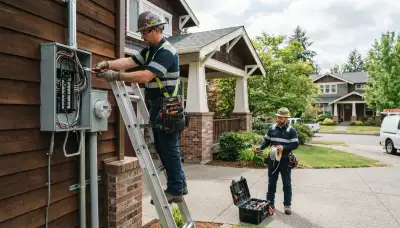
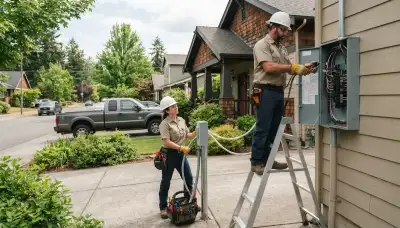
A local electrician working in Auburn recognizes the construction patterns in these houses: where the panel sits, how the crawlspace or basement shapes every new circuit run, and which wiring decisions from the original build still cause problems today.
The two kinds of work that come up most often are panel capacity jobs and circuit additions where the existing wiring cannot carry what the room now demands. Homeowners in Federal Way, WA deal with similar issues on houses from the same period.
If a breaker trips every time two appliances run at once, or an outlet near a sink has no reset button, that is not a minor inconvenience - it is a problem that grows until something fails.
Electrical Work Matched to How Auburn Homes Are Built
An off-the-shelf approach fails in Auburn because the houses here were built on crawlspaces and wood frames, with panels tucked into garages or utility closets, and running a new circuit through those spaces is a different job than it looks from the outside.
Some houses here are single-story wood frames over a crawlspace where pulling wire means working under the floor; others are two-story detached homes where a circuit to the garage or a detached shed adds outdoor conduit runs to the job. Expert ceiling fan installation in a two-story home with no attic access is a wall-opening job, not an afternoon swap.
Four kinds of work fit these homes particularly well: quality recessed lighting installation for rooms where fixture boxes were never planned, reliable generator installation for detached structures that need their own feed, specialist GFCI circuit work near every sink and bath, and professional electric car charger installation in garages where the panel has no room to spare.
When Auburn Homes Were Built Still Shapes What They Need
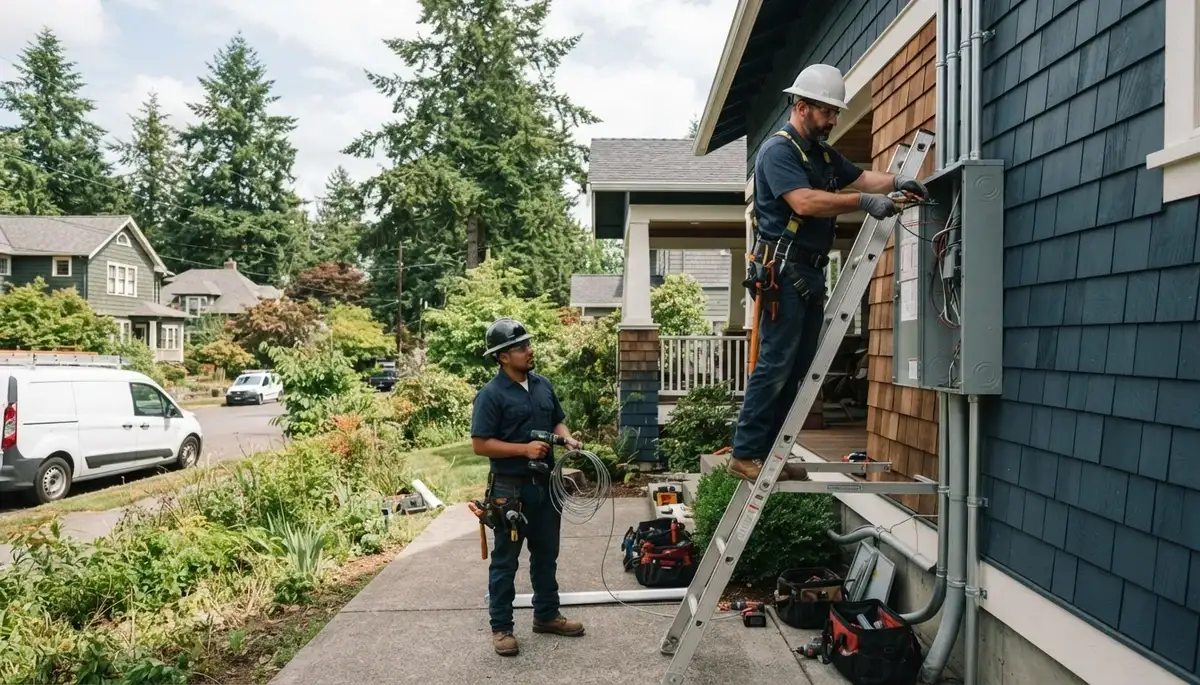
Most of the houses in Auburn went up from the late 1950s through the 1970s, a stretch when builders installed 60- to 100-amp panels, two-prong ungrounded outlets, and in the years around 1968 to 1972, aluminum branch wiring that was cheaper at the time and is a known problem now. Three things follow from that era and still shape every service call: the panel is almost certainly full, the outlets in older rooms are probably ungrounded, and any home from that aluminum-wiring window deserves a close look at every connection point.
The Panel Has No Room Left
Homeowners notice it when an electrician opens the box and every slot is taken, or when a double-tapped breaker turns up on an inspection report. A 100-amp panel sized for a house with one bathroom and no air conditioning cannot carry what Auburn homes run today without tripping constantly or running hot.
Local electricians replace the panel or add a subpanel to restore capacity, and the fix holds because the new equipment is sized for what the house actually draws, not what it drew in 1965.
Outlets That Have No Ground
Two-prong outlets throughout the house mean the wiring behind them was installed before grounding was required. Plugging a three-prong adapter into an ungrounded outlet does not add protection - it just changes the shape of the opening.
Replacing ungrounded outlets with outlets that have test and reset buttons, or running a new grounded circuit, gives the homeowner real protection at those points and removes the workaround that has been there for decades.
Connections That Run Hot
In homes from the late 1960s and early 1970s, aluminum wiring was run to outlets and switches throughout the house. Over years of use, aluminum connections loosen and oxidize at the terminal points, and a loose aluminum connection runs warm, then hot, then becomes a fire risk.
Local electricians inspect every connection point, install approved aluminum-rated devices, and apply the correct compound at terminals, which stops the oxidation cycle and brings the outlet back to a safe operating temperature.
A Service That Was Never Sized for What Was Added
Car chargers, window air conditioners, chest freezers in the garage, and shop tools all draw more than the original service was sized to handle. On a hot afternoon when the air conditioning runs hard, a single added load can push a 100-amp panel past its limit.
Adding a subpanel or upgrading to a 200-amp service gives the house enough capacity to run the charger, the air conditioning, and the kitchen at the same time without a breaker tripping, and without the panel running warm all summer.
Crawlspace Access That Changes the Whole Job
In a wood-frame house over a crawlspace, pulling a new circuit to a bathroom or a back bedroom means working under the floor in a space that may be tight, damp, or partially blocked by old ductwork.
Local electricians plan the route before opening anything, use flexible conduit where the path bends, and route through the crawlspace in a way that does not require cutting into finished ceilings or walls - keeping the job clean and the disruption short. Homeowners in Puyallup, WA with the same crawlspace construction face identical access challenges on comparable jobs.
Call (253) 358-8585 to arrange a no-pressure visit with a local electrician who can look at what the house actually has and tell you what it needs before anything gets worse.
On Call Electrical delivers work that holds, in Auburn homes built to last.

Full Electrical Services Available in Auburn, WA
The work below covers the full range of what a local electrician handles in Auburn, WA. Find what matches your situation and call to get it scheduled.
Urgent Electrical Repairs for Auburn, WA Homes
- Electrical Repair - A breaker that trips every time the microwave and toaster run together points to a circuit that has been overloaded for years in these houses.
- Outlet Repair - An outlet warm to the touch or one that sparks when something is plugged in needs attention the same day, not next week.
- Switch Repair - A switch that buzzes, flickers the light, or feels loose in the wall is a connection that has worked itself free over years of use.
- GFCI Circuits - Bathrooms and kitchens in homes built before the mid-1970s often have no outlets with test and reset buttons anywhere near water.
- Home Electrical Inspections - A house that has not been looked at in ten years or more may be carrying problems the owner cannot see from the surface.
If any of these match what you are dealing with, a local electrician can tell you what it involves and what it will take to fix it.
Panel, Capacity, and Wiring Work in Auburn, WA
- Electrical Panel Upgrade - A 60- or 100-amp panel in a house that now runs a charger, air conditioning, and a full kitchen was never sized for that load.
- Electrical Panel Installation - Replacing a fuse box with a modern breaker panel is the single change that opens the most capacity in an older Auburn home.
- Electrical Wiring - Houses from the 1960s and 1970s may have wiring that has never been touched since the original build, and some of it needs to be replaced.
- New Construction Wiring - Additions, garage conversions, and accessory dwelling units need wiring planned from the start, not added onto an already-full panel.
- Electrical Service - A service entrance that was installed decades ago may not meet what the house draws today, and the upgrade starts at the point where power enters the building.
Capacity work in Auburn homes often uncovers two or three related problems at once, because the original wiring was installed all at the same time and it ages together.
Safety and Protection Services in Auburn, WA
- Smoke Detector Installation - Detectors that are more than ten years old or that chirp without stopping need to be replaced before they stop responding to an actual fire.
- Fire Alarm Installation - A house with a finished basement or a detached workshop needs detection coverage in those spaces, not just in the main living area.
- Whole Home Surge Protection - A single power surge can damage every appliance and device in the house at once; protection installed at the panel stops it before it reaches any outlet.
- Lightning Surge Protection - Homes with large outdoor electrical runs to sheds, pools, or outbuildings are more exposed to a surge traveling in from outside.
- Home Energy Audit - An audit finds where the electrical system is working harder than it should and points to the changes that bring the biggest improvement.
Safety work in Auburn homes from the 1960s and 1970s often starts with a single concern and turns up two or three others that were invisible until an electrician opened the panel or pulled an outlet. Getting all of it handled at once is almost always the better path, and local electricians can walk through the whole picture in a single visit.
Lighting, Outdoor, and Added-Load Work in Auburn, WA
- Recessed Lighting Installation - Rooms in these houses were built with a single ceiling fixture and no path for additional lighting; recessed lights require planning the route through the ceiling or the crawlspace above.
- Landscape Lighting - Outdoor lighting runs in Auburn homes need weatherproof connections and circuits that were sized for the load, not tapped off whatever was closest.
- Electric Car Charger Installation - A Level 2 charger in the garage needs a dedicated 240-volt circuit, and most Auburn garages do not have one.
- Generator Installation - A standby or portable generator tied to the panel through a transfer switch keeps the house running when power goes out, without backfeeding the line.
- Ceiling Fan Installation - Adding a ceiling fan to a room that has only a light fixture means running a new switch leg and sometimes reinforcing the box in the ceiling to carry the added weight and movement.
Outdoor and added-load work in Auburn often involves running new circuits from a panel that is already near capacity, which is why the panel conversation and the added-load conversation happen at the same time with a local electrician.